



Michael Usher on the 7NEWS Spotlight's prison interview that 'never happens'
'Getting media in there is almost unheard of ... to interview someone like this? It never happens.'

Michael Usher says it’s the rarest story of his career, and it took more than eight months, multiple government approvals and a week inside one of Australia's toughest prisons to make it to air.
The upcoming 7NEWS Spotlight episode, Face-To-Face With My Children’s Killer, follows the meeting between Danny Abdallah and Samuel Davidson, the man who killed three of his children and their cousin in the 2020 Oatlands tragedy.
For Usher and his team, the real story began long before the cameras rolled.
Securing permission to film a high-risk, high-security inmate meant navigating Corrective Services NSW’s restorative justice program, a process so rare it is approved only in exceptional circumstances and requires the consent of both victim and offender.
“Getting media in there is almost unheard of,” Usher told Mediaweek. “To interview someone like this? It just doesn’t happen.”
 Siblings Antony, 13, Angelina, 12, and Sienna, 8, along with their cousin Veronique Sakr, 11, were killed by Davidson.
Filming inside maximum security
Logistically, the shoot was one of the most complex Usher has tackled.


The leading media trade publication in Australia.
Get our top stories straight to your inbox daily by signing up to our Newsletter
By providing your information, you agree to our Terms of Use and our Privacy Policy. We use vendors that may also process your information to help provide our services.
“We had three cameramen, a producer, an assistant, plus a whole Corrective Services team,” he said. All personal items were surrendered, and three carloads of equipment were locked inside the prison for the duration of filming. Moving between locations required lockdowns to avoid disrupting operations.
Access extended all the way into Davidson’s cell, “almost unheard of,” Usher said, to show his daily reality. He stressed that Davidson’s cooperation carried no benefit to his sentence. “It doesn’t knock a single hour or day off. This was about two people, whose lives are tragically intertwined, trying to understand each other better.”
Faith, forgiveness and complexity
The meeting also delved into Davidson’s conversion to Christianity, which Usher believes is sincere and partly inspired by Danny and Leila Abdallah. “If I were cynical, I might think it’s a way to look good. But my impression is that he’s honestly chosen it. His faith is strong, and that makes it more powerful,” Usher said.
For the Abdallahs, forgiveness has been a long and raw process. “It’s not straightforward or easy. It challenges Danny at times, and he’s said that on camera. But their faith keeps forgiveness at the core,” Usher said.
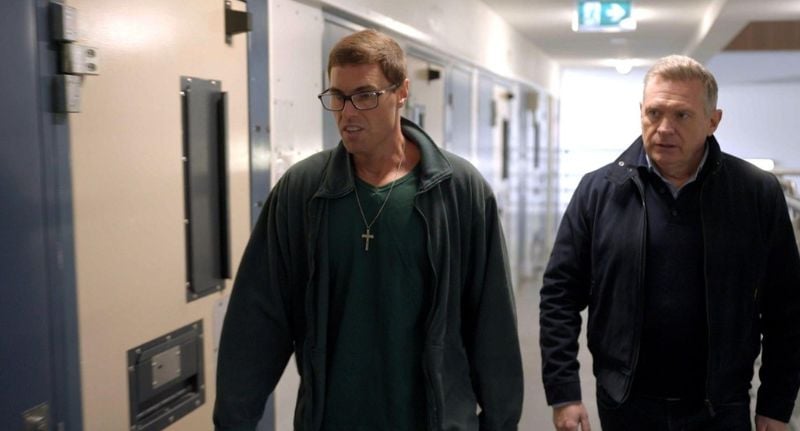 Michael Usher stands with Samual Davidson in jail.
The personal toll
Usher admits stories like this stay with him. “These interviews can last hours, over days. You’re prosecuting every angle, good and bad, and that’s a huge emotional drain. I tell people after a big interview, ‘You’ll be tired tonight.’ You’re concentrating, processing, reliving things.”
In maximum security, there are no second chances to get missed questions. “You can’t go back in. We had strict checklists, and I still worried, did I ask everything? Did I miss something?”
After decades in journalism, Usher says he’s learned to compartmentalise, but some stories linger. “I can put it in a part of my brain and say, ‘We’ll come back to that later.’ But the big ones, I’m still thinking about them two days later. My family might argue I don’t switch off as well as I think.”
What has he walked away with?
“That forgiveness is far more complex, and powerful, than I ever understood,” he said.
“And that stories like this remind you journalism isn’t just about telling what happened, it’s about trying to understand why.”
More from Mediaweek
The leading media trade publication in Australia.
Get our top stories straight to your inbox daily by signing up to our Newsletter
By providing your information, you agree to our Terms of Use and our Privacy Policy. We use vendors that may also process your information to help provide our services.


